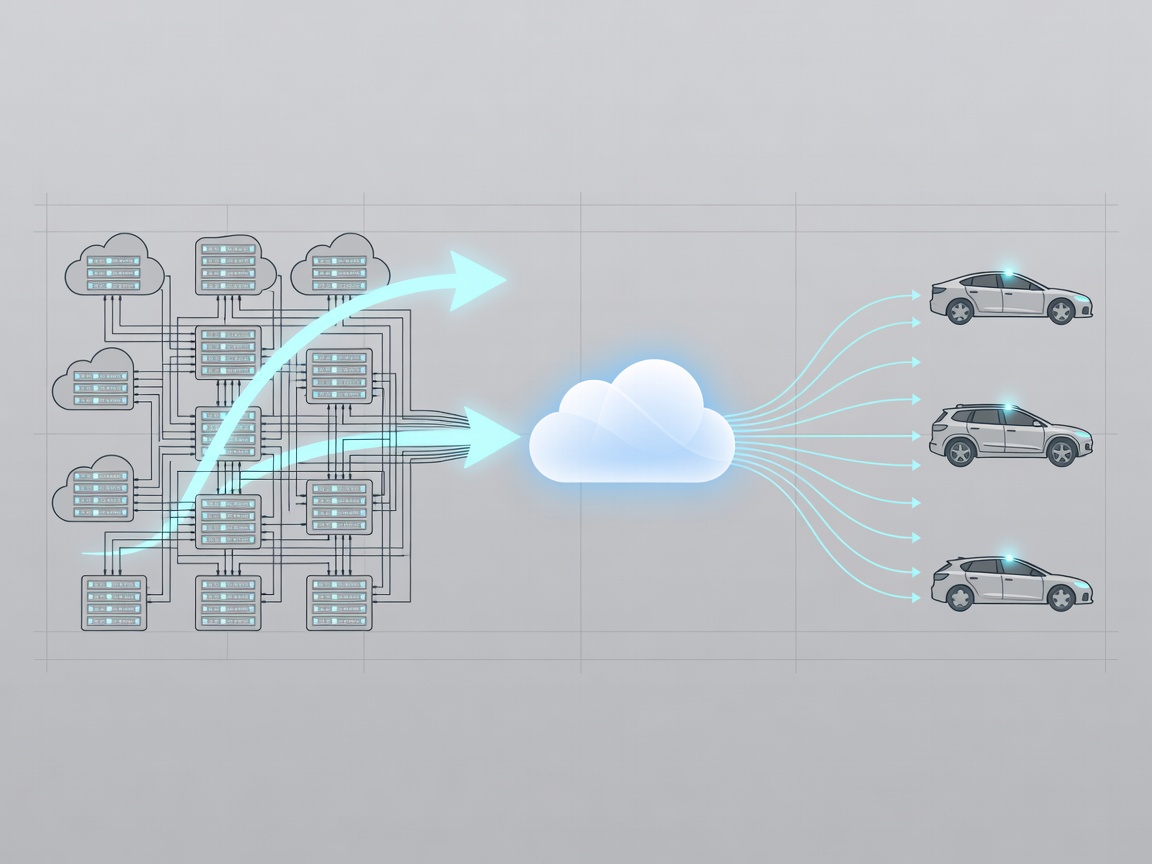
The transition from hardware-defined to software-defined vehicles (SDVs) relies entirely on a robust Over-The-Air (OTA) update architecture. Without the ability to reliably, securely, and seamlessly update vehicle software after it leaves the dealership, the promises of the SDV remain unfulfilled. This guide explores the architectural paradigms required to execute OTA updates at scale, focusing on partitioning strategies, bandwidth optimization, and fallback mechanisms.
The Anatomy of an OTA Campaign
An OTA architecture spans multiple domains: the cloud backend (OTA server), the secure communication channel, and the in-vehicle architecture. The cloud backend manages campaign creation, vehicle targeting, and release management. It maintains a digital twin of every vehicle's hardware and software configuration to ensure compatibility before an update is dispatched.
Within the vehicle, the architecture typically centers around a primary Telematics Control Unit (TCU) or Central Gateway, which acts as the OTA Client. This client is responsible for downloading the payload, verifying cryptographic signatures, and orchestrating the distribution of updates to downstream Electronic Control Units (ECUs) across various automotive buses (Ethernet, CAN FD, LIN).
A/B Partitioning and Seamless Updates
One of the most critical requirements for modern automotive OTA is the seamless update experience, meaning the vehicle remains operational during the download and installation phases. This is achieved through A/B partitioning (also known as dual-bank memory).
In an A/B architecture, the flash memory of the target ECU is divided into two identical partitions. If the system is currently running from Partition A, the OTA client writes the incoming update to Partition B in the background. Once the download and verification are complete, the system simply updates the bootloader pointer to boot from Partition B on the next ignition cycle. If the new software fails to boot or exhibits critical errors, the system can automatically rollback by switching the pointer back to Partition A.
Pros and Cons of A/B Partitioning
- Pros: Zero downtime during installation, inherently safe rollback capabilities, lower risk of bricking the ECU during power loss.
- Cons: Requires double the flash memory on the ECU, increasing hardware costs; requires complex bootloader management.
Delta Updates and Bandwidth Optimization
Automotive software payloads can easily exceed several gigabytes, especially when updating infotainment systems (IVI) or Advanced Driver Assistance Systems (ADAS). Transmitting full binary images over cellular networks to fleets of millions of vehicles incurs massive data costs and requires extended periods of high connectivity.
To mitigate this, sophisticated OTA architectures utilize delta (or differential) updates. A delta generation algorithm on the cloud backend compares the target vehicle's current binary with the new binary and extracts only the differences. The resulting delta payload is often orders of magnitude smaller than the full image. The in-vehicle OTA client then takes this delta file and patches the existing software bank to create the new binary.
Orchestration and Dependency Management
A vehicle is a distributed system. Updating one ECU often requires simultaneously updating another to maintain API compatibility. For example, updating a zone controller might require a concurrent update to an actuator node. The OTA orchestrator must handle these complex dependency graphs, ensuring that if one downstream update fails, the entire transaction is rolled back to maintain a consistent state.
As architectures migrate toward centralized compute platforms with hypervisors running multiple virtual machines, the OTA process shifts from flashing bare-metal ECUs to orchestrating containerized application updates via OCI (Open Container Initiative) standards, mirroring cloud-native DevOps practices.